This new Committee looks after a combination of Playing fields, the Play areas, the grounds of the Cemetery, Boxhill and Rudloe common spaces, Lovar Garden and Lacy Wood. There are extensive facilities to manage across the Parish.
Playing Fields
The playing fields comprise of 11 acres and was donated to the Council under a Deed of Gift in 1926 by a Mr George Kidston of Hazelbury Manor.
There were conditions laid down for the use of the grounds for recreation which included the Box Cricket Club.
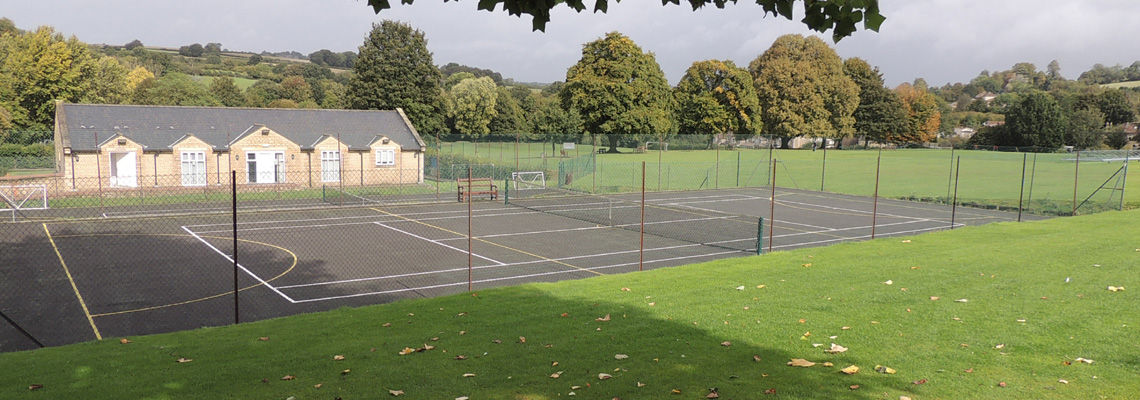
Today the play grounds contains the following amenities which include; the cricket pitch, two tennis courts, a national standard bowling green, children under seven play area besides a play area for the older children. It also has a basketball court, BMX track, football and rugby pitches.
Box Rock Circus, installed in 2012 is unique, incorporating samples of all three rock types, minerals and fossils. The blocks demonstrate Britain's plate tectonic movement through time and the marks on the outer granite setts demonstrate the major events in the evolution of life. By looking at the dinosaur footprints you can work out the height of the dinosaurs. As well as being educational, the blocks are fun for children to climb and the fossil rubbings create great artwork. For further information see: www.boxrockcircus.org.uk
Box Cemetery
Over 130 years ago, the then village council, then represented by the Church Vestry, decided that a new burial ground was required after the graveyard at St Thomas à Becket had insufficient space. On 26 January 1858, the Vestry decided to create a Burial Board which was to obtain the land for the new cemetery, lay out the site, arrange for the construction of a chapel, lodge and entrance gates and then to manage the cemetery. The land was given by Mr Northey and was described as part of a field adjoining the Turnpike Road, known as Nap Stile or Great Lye Mead. Dates of completion are not recorded, but the site was probably laid out before it was consecrated by the Lord Bishop of Gloucester & Bristol on 9 December 1858 for interment of the dead, according to the rites of the United Church of England and Wales.
Parish Councils were established by Act of Parliament in 1894 and the affairs of the Burial Board subsequently came under the jurisdiction of the new Parish Council, instead of the Vestry. In April 1896, the Burial Board met and resolved to hand over its authority to the Parish Council. So from that date the affairs of the Cemetery, or more accurately the Burial Grounds, have been managed by the Burial (now Cemetery Management) Committee of Box Parish Council. Almost five decades later it became necessary to extend the Burial Grounds, so in 1943 a further area of land to the east of the Burial Grounds was acquired from Mrs Shaw-Mellor and became known as the New Cemetery.
Boxhill, and Rudloe
The stated object of the society was The preservation of the Common as an open space for the recreational and leisure use of the inhabitants of the Parish of Box. The rules for the usage of the Common were outlined as:
No motor vehicles, no overnight parking, no dumping or tipping, no unauthorised planting or cutting, fires and grazing only with permission.
Professional advice was needed and Wiltshire Wildlife Trust developed a management plan for the sustainability of the site.
This focused on encouraging flowers needed to sustain the important bat population which roost in the old stone mine and discouraging invasive ash and sycamore trees from turning it all into woodland. There were many issues to be considered.
Joan Woodgate gave advice as an expert on the flora of the site. Bath University lecturer and presenter of the BBC's 1987 television series The Victorian Kitchen Garden, Peter Thoday, agreed to act as a consultant. Peter led working parties to root out ash and sycamore, wielding his trusty mattock (chopper).
In 1980 two hundred beech saplings were bought in and planted with a grant from the Campaign to Protect Rural England to replace the aging beech shelter belt. These are the trees we now see standing from Tisbuts Cottage to the corner of Quarry Hill.
It was agreed that the top common should be cut twice a year with the cuttings taken away to prevent re-seeding. The lower common was to be left more naturally to preserve the orchids there. And throughout the work two primary aims were needed:
to allow public access to the site through the maintenance of footpaths, and to ensure the site was kept as a wild, open space,
not a manicured, formal garden.
Lacy Wood
To follow.
The Lovar Water Garden
The Lovar Garden at the foot of the Lower Rec was the initiative of Ronnie Walker, chairman of Box NATS. The project was funded by a charity, the Lovar Foundation, of which Ronnie was also chairman.[1] It was opened on 3 June 1997 as a parish amenity for the enjoyment of nature.
A number of agencies were involved in its creation including Box Parish Council, Cotswold National Landscape, Wessex Water and GWR. The site is complex because it had previously been a sewer bed and overflow for storm rainwater from houses on the High Street and frequently flooded. It was also in a difficult location to maintain at the foot of The Rec. However, it has a very broad range of wildlife habitats including wetland, woodland and banks. The flat access from Mill Lane offers tranquillity for those wanting to relax. It is also in an attractive location, close to the Brunel Underpass bridge which has recently been awarded a Grade II Historic Buildings Listing.
*************************************************************************************************************************************
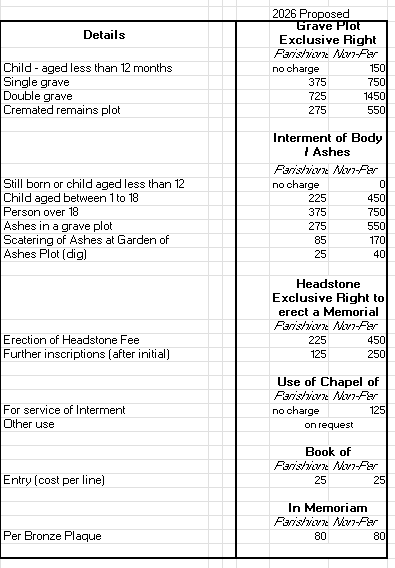
Table of Fees for Cemetery 1st April 2025 to 31st March 2026